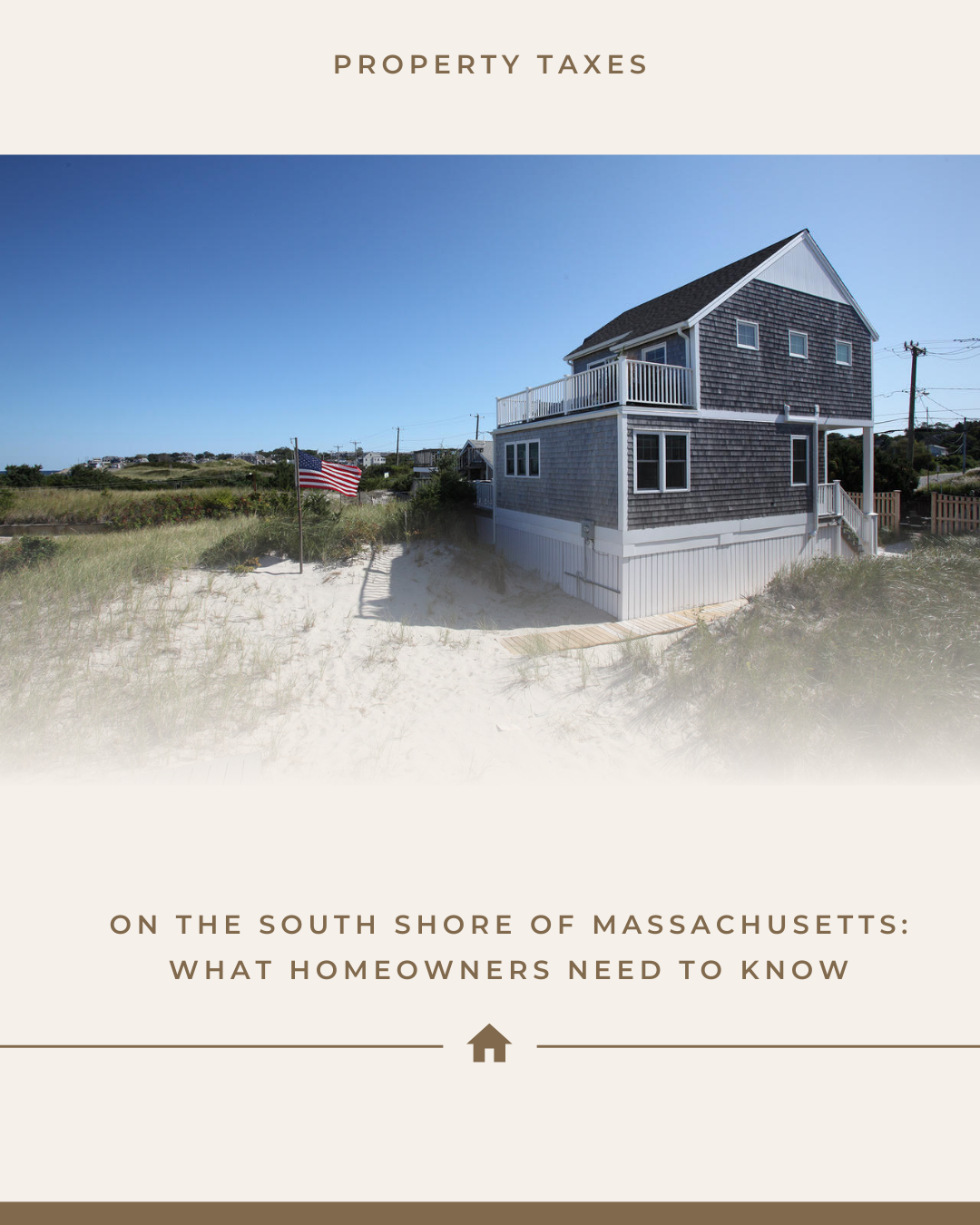
Property taxes directly impact affordability, monthly budgeting, and long-term ownership costs, and they vary significantly from town to town.
Here’s what South Shore homeowners and buyers should know.
How Property Taxes Are Assessed in Massachusetts
In Massachusetts, each town or city has a local Board of Assessors that determines property values.
Assessments are based on:
Size of the home
Lot size
Location
Age and condition
Comparable sales
Market trends
By state law, assessors must reflect full and fair cash value, which is essentially market value.
Property taxes are expressed as dollars per $1,000 of assessed value.
For example:
If a home is assessed at $600,000 and the town’s tax rate is $12 per $1,000, the annual property tax would be:
600 × 12 = $7,200 per year
Tax rates vary widely across South Shore communities. For example:
Quincy may differ significantly from Duxbury
Plymouth’s rate differs from Hingham’s
School funding priorities affect rates town by town
This is why comparing home prices alone doesn’t tell the full affordability story.
Proposition 2½: How It Impacts South Shore Property Taxes
Massachusetts operates under Proposition 2½, which limits how much a municipality can increase its total property tax levy each year.
Here’s what that actually means:
A town can increase its total tax levy by 2.5% per year, plus revenue from new growth (new construction, renovations, etc.)
Towns can exceed this limit only with voter approval through an override.
Important clarification:
Proposition 2½ limits the total levy, not necessarily your individual tax bill. Your specific property tax may still change more than 2.5% if your home’s assessed value changes relative to others in town.
On the South Shore, overrides sometimes occur to fund:
School expansions
Public safety improvements
Infrastructure projects
It’s always wise to understand a town’s budget priorities before buying.
Why Property Taxes Vary Between South Shore Towns
Each municipality sets its own budget annually.
Property taxes fund:
Public schools
Police and fire departments
DPW services
Libraries
Municipal infrastructure
Economic development plays a role too. New growth helps offset tax pressure by expanding the tax base.
What Happens After You Buy a Home?
Assessments are updated regularly to reflect market value.
If your purchase price is significantly higher than the current assessed value, the town may adjust the value during its next revaluation cycle.
Many South Shore towns conduct:
Annual interim adjustments
Full revaluations every few years
So while a sale does not trigger an automatic reassessment, market trends influence future assessments.